
Port Augusta
Iron Knob
Kimba
Wudinna
Minnipa
Poochera
Wirrulla
Streaky Bay
Smoky Bay
Ceduna
Denial Bay
Penong
Cactus Beach
Fowler's Bay
Nundroo
Yalata
Head of Bight
Nullarbor
Border Village
Eucla
Mundrabilla
Madura
Eyre Bird
Observatory
Cocklebiddy
Caiguna
Balladonia
Norseman
Kambalda
Kalgoorlie
Coolgardie
Esperance

Adventure travel
- at its best!

A good time
Down Under!
 


|
Eyre Bird ObservatoryEyre Bird Observatory is located approximately 50 kilometres southeast of Cocklebiddy. Eyre Bird Observatory is a very remote site situated 1 kilometre to the north of the Great Australian Bight. Europeans first ventured into this area of the Bight in March 1841. At the time Edward John Eyre, his trusted friend John Baxter, and aboriginal companions Wylie, Joey and Yarry were engaged in a do or die effort to cross the Nullarbor. Of the expedition members, only Eyre and his friend Wylie were to survive. Eyre's epic crossing of the Nullarbor was a truly harrowing one, with the party constantly suffering exhaustion, starvation and the ever present possibility of death due to thirst. During this epic exploration, Eyre's expedition was forced to lay up and recuperate at "Eyre's Sandpatch" - site of the present day Eyre Bird Observatory. According to Eyre's journal the "Sandpatch" proved to be their salvation. At the time Eyre's party was suffering a slow lingering death from starvation, and more importantly, no native water wells had been discovered during the previous seven days. Incredibly Eyre's expedition discovered a source of water at the Sandpatch by digging a well to a depth of over 2 metres through fine white sand. Eyre's party then camped at the "Sandpatch" for another 29 days, before heading west to confront further tragedies.
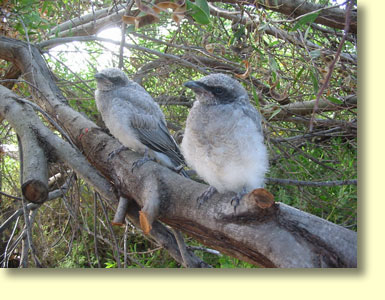
Today Eyre Bird Observatory is a nationally significant site for ornithological and environmental research. Surrounded by the Nuytsland Nature Reserve, this area of Australia is home to over 240 species of birds - and many of them are rare and endangered. Rare species recorded in Nuytsland Nature Reserve include Major Mitchell Cockatoos and the unique Mallee Fowl which incubates its eggs in mounds of leaf litter and sand.
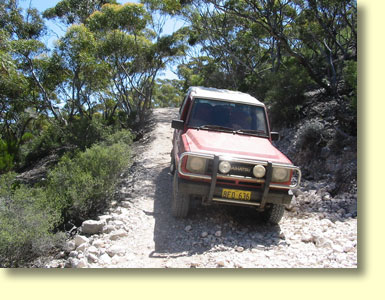
For Nullarbor travellers a short visit to Eyre Bird Observatory could prove most rewarding. Eyre Bird Observatory is situated on some of Australia's most remote coastline. Throughout the year Eyre Bird Observatory conducts a number of courses designed to attract the interest of naturalists and people with a growing sense of environmental consciousness. Eyre Bird Observatory is located approximately 50 kilometres southeast of Cocklebiddy. Access to Eyre Bird Observatory is provided by a turnoff from the Eyre Highway. This turnoff is located approximately 17 kilometres east of Cocklebiddy. To drive all the way to Eyre Bird Observatory a 4 wheel drive vehicle with good clearance is essential.
Conventional vehicles can travel along the access road as far as the lookout; located 4km past the microwave tower. Please note road conditions in the area can be variable. At Eyre Bird Observatory day visitors are welcome and a modest entry fee is charged, which includes a guided tour of the facility and access to the surrounding area. Eyre Bird Observatory also provides overnight accommodation including meals. Should you not possess a 4 wheel drive vehicle a pick up and drop off service is offered by the Caretakers of Eyre Bird Observatory, for guests staying two or more nights. Eyre Bird Observatory is definitely a plus for aspiring photographers, naturalists and the more serious David Attenborough types of this world! For accommodation prices and further information contact Eyre Bird Observatory by telephoning (08) 9039 3450 or Fax (08) 9039 3440. Alternatively view the Eyre Bird Observatory visitor and accommodation link on that page for the most current accommodation rates. Email contact can be made at eyre@birdlife.org.au. To avoid disappointment advance bookings are essential.
|