 Nullarbor Net
The Nullarbor: Anything But Plain
Flat, wide and almost treeless: the Nullarbor Plain.
Photo: Ross Bate, CC BY 3.0, via Wikimedia Commons
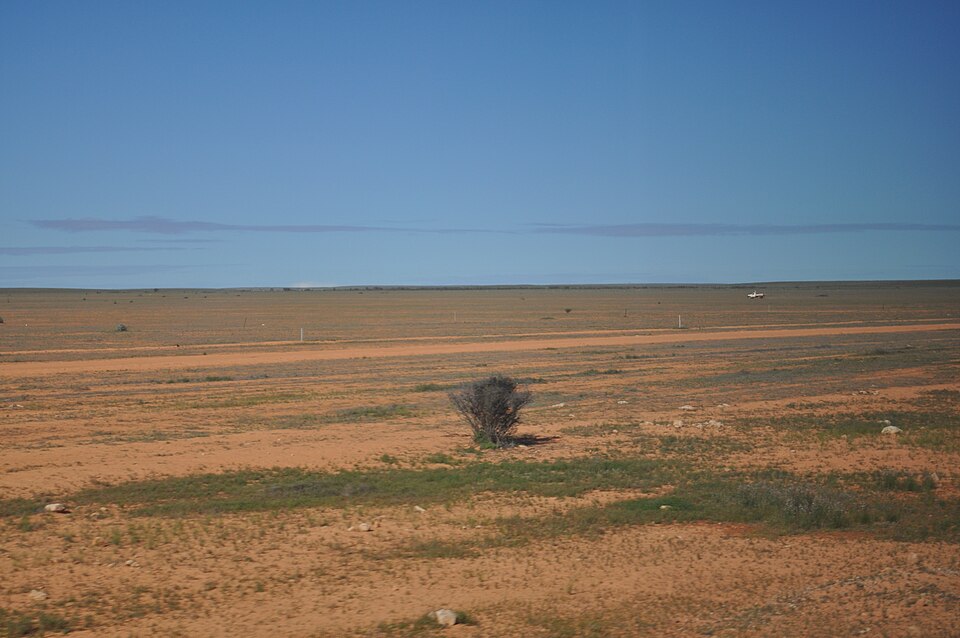

Most travellers see the Nullarbor through a windscreen — mile after mile of saltbush, bluebush and a horizon that never seems to get any closer. But scratch the surface (literally) and the Nullarbor turns out to be one of the most remarkable scientific landscapes on Earth. Here are a few of our favourite facts to keep you entertained between roadhouses.
A Sea of Stone
The Nullarbor Plain covers about 200,000 square kilometres and is the world's largest single exposure of limestone bedrock. Amazingly, every bit of it was once the bottom of a shallow sea. The limestone is made from the skeletons of tiny sea creatures — bryozoans, foraminifera, sea urchins and red algae — which settled on the seabed during the Miocene, a period geologists date from about 23 to 5 million years ago. The seabed was later lifted up and left high and dry. So when you pull over for a cuppa on the Nullarbor, you are quite literally parked on an ancient ocean floor.
No Trees? Blame the Romans!
Well, not quite. The name comes from the Latin “nulla” (no) and “arbor” (tree), and was first used in 1866 by surveyor Edmund Delisser, who was struck by the complete lack of trees — see our Nullarbor Roadhouse page for more. So why are there no trees? Scientists point to a combination of thin soils sitting on top of the limestone, very low rainfall (the long-term average at Cook on the railway line is just 184 millimetres a year), and the fact that what little rain does fall quickly drains down through the rock and out of reach of thirsty roots. Low saltbush and bluebush are about the only plants tough enough to cope.
Once Upon a Forest
Here is the twist. The Nullarbor hasn't always been treeless. In 2016, University of Melbourne scientists dated fossil pollen trapped inside Nullarbor cave formations — stalagmites, stalactites and flowstones. They found that around five million years ago the Plain went through a “big wet”. In just 100,000 years it became a forest of gum trees and banksias, with two to four times today's rainfall. The big wet lasted until about 3.5 million years ago, before the Nullarbor dried out into the landscape we cross today.
The Plain That Breathes
Looking down into the Caiguna Blowhole.
Photo: Calistemon, CC BY-SA 4.0, via Wikimedia Commons
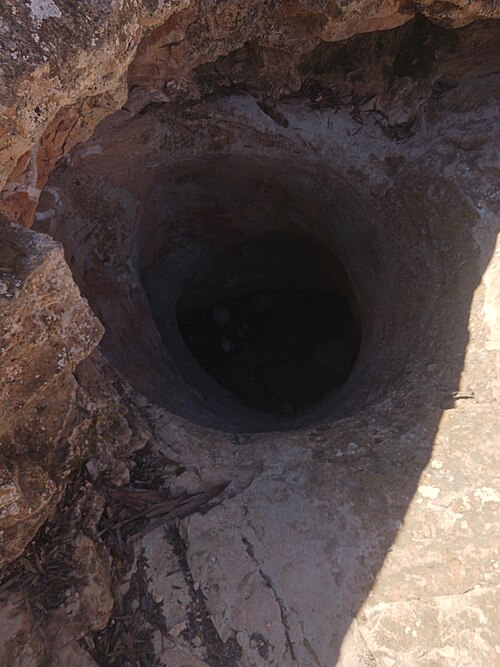

Beneath your wheels lies what scientists believe is the largest continuous karst (cave country) landscape in the world, riddled with caves, sinkholes and thousands of narrow vertical tubes called blowholes. Stand beside one and you may feel a strong rush of air — in or out. The blowholes “breathe” because the air pressure in the huge caverns below is always trying to catch up with the air pressure above ground. When a weather system brings falling pressure, the caves exhale; when pressure rises, they inhale. You can feel it for yourself at the Caiguna Blowhole, 5 kilometres west of Caiguna, right beside the Eyre Highway.
Holding Your Breath at Cocklebiddy
Ten kilometres north west of Cocklebiddy Roadhouse lies one of the most famous underwater caves on the planet. Cocklebiddy Cave runs through flooded tunnels deep beneath the Plain, and in 1982 divers reached “Toad Hall” — a dry chamber 10 metres high and 250 metres long, hidden deep inside the cave. Why “Toad Hall”? According to Australian cave divers, that remains “a secret kept by those who have ventured there”! In August 1983 a French team led by brothers Francis and Eric Le Guen set a world record for the longest cave dive. Just two months later an Australian team went even further, with Hugh Morrison of Western Australia pushing another 240 metres beyond the French line. That expedition spent 55 hours underground and dived more than 10.5 kilometres underwater on the round trip. And no, you can't drink the water — it's too salty.
The Lion Sleeps Tonight
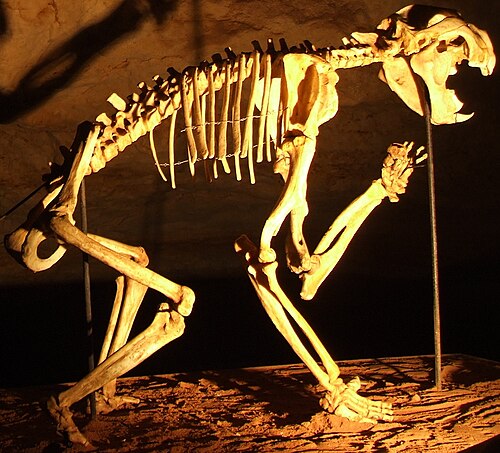
A marsupial lion skeleton on display at Naracoorte Caves, South Australia.
Photo: Karora, public domain, via Wikimedia Commons
.jpg)
In 2002, Father Ken Boland — a priest and keen cave diver — flew an ultralight aircraft back and forth over the Nullarbor looking for cave openings. Out of 1,500 possible sites, his team found three new caves. Inside one of them lay something no one had ever seen: a complete skeleton of Thylacoleo carnifex, the extinct marsupial lion. Marsupial lion bones had turned up in every Australian state, but never a whole skeleton. The Nullarbor's dry, cool and stable caves had preserved it for somewhere between 500,000 and 780,000 years, and the bones had not even turned to stone. According to the Western Australian Museum, the marsupial lion had a bite more powerful than any known mammal, plus an opposable thumb for climbing.
An artist's impression of the giant short-faced kangaroo.
Photo: Stanton F. Fink, CC BY 3.0, via Wikimedia Commons
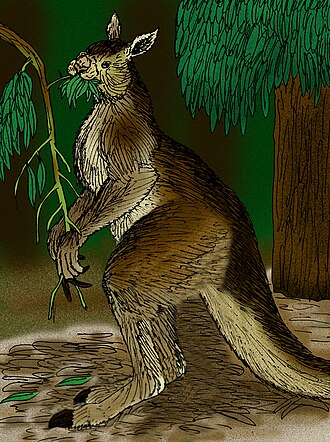

Its neighbours included Procoptodon goliah, a giant short-faced kangaroo weighing up to 200 kilograms and standing up to 3 metres tall. Thankfully, both are long gone!
Fingerprints in the Dark
Koonalda Cave, west of Nullarbor Roadhouse, is one of the most important Aboriginal sites in Australia. Deep underground, in total darkness, Aboriginal people mined flint for making tools and left thousands of square metres of finger markings pressed into the soft cave walls — markings dated at around 20,000 years old. Koonalda Cave was placed on the National Heritage List in 2014. It is a protected site and is not open to visitors.
Heavy Metal From Outer Space
The 12.4 tonne main mass of the Mundrabilla meteorite at the Western Australian Museum.
Photo: Graeme Churchard, CC BY 2.0, via Wikimedia Commons
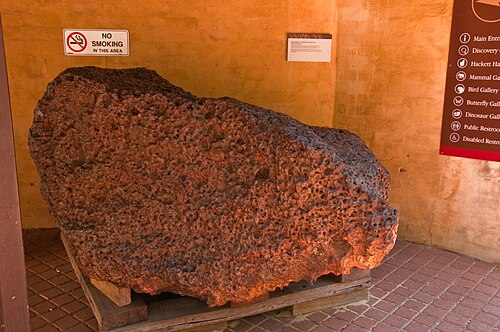

In April 1966, geologists working near Mundrabilla stumbled across two enormous lumps of iron lying about 180 metres apart. They turned out to be pieces of a meteorite — one weighing 12.4 tonnes and the other 5.44 tonnes. In all, about 22 tonnes of the Mundrabilla meteorite have been recovered, making it the largest meteorite ever found in Australia. And Mundrabilla is far from alone. According to the Western Australian Museum, the WA side of the Nullarbor has given up several thousand fragments from about 200 different meteorites — roughly half of all the meteorites known from Australia. Why here? A dry climate keeps meteorites from rusting away, there is very little vegetation to hide them, and a dark space rock really stands out against pale limestone. Keep your eyes peeled!
Littering From Space
Skylab in orbit above the Earth in 1974, five years before it fell.
Photo: NASA, public domain, via Wikimedia Commons
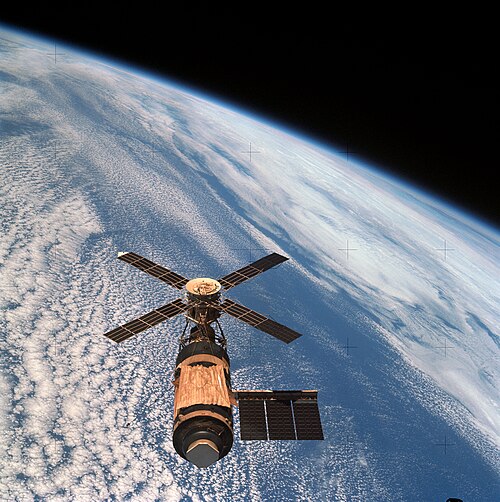

The Nullarbor's most famous space visitor didn't come from nature at all. On 11 July 1979, the American space station Skylab came crashing back to Earth, scattering pieces across the outback around Balladonia. The Shire of Esperance responded by issuing NASA with a $400 fine for littering! The fine went unpaid for 30 years, until 2009, when American radio host Scott Barley and his listeners finally settled the bill. You can see pieces of Skylab for yourself at the museum in the Balladonia roadhouse.
Dead Straight
The Trans-Australian Railway looking east from Cook.
Photo: Wikipedia user 17177, CC BY-SA 3.0, via Wikimedia Commons
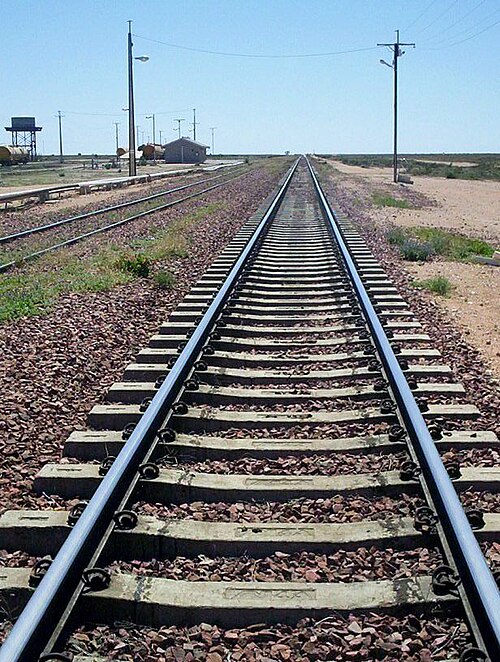

If you're travelling by train rather than car, the Trans-Australian Railway across the Nullarbor has the longest straight section of railway in the world — 478 kilometres without a single curve. Motorists aren't left out either — the Eyre Highway's 90 Mile Straight between Caiguna and Balladonia is Australia's longest straight stretch of road.
More Nullarbor planning
- The Bunda Cliffs
- Crossing the Nullarbor: the complete guide
- Nullarbor Links golf course
- EV charging on the Nullarbor
- Nullarbor fuel stops and distances
- Nullarbor quarantine rules
- How many days to cross the Nullarbor
- Nullarbor time zones
- The 90 Mile Straight
- Free camps and rest areas
- Perth to Adelaide drive
- Melbourne to Perth drive
- Sydney to Perth drive
- Best time to cross and weather
- Towing a caravan across the Nullarbor
- Phone coverage and emergencies
Spotted something out of date? Please let us know.